
Product Center
Service hotline
+86-13035117088Current page: Home > ApplicationApplication
1. Copper Foil Anti-Oxidation Treatment: Industry Background & Mainstream Processes
Copper foil serves as the core conductive substrate for PCBs, lithium batteries and precision electronic components, featuring excellent electrical conductivity and ductility. However, freshly electroplated copper foil has a highly active surface with unstable grains. It is prone to oxidation, discoloration and corrosion under air, high-temperature & high-humidity, as well as acidic and alkaline working conditions. This leads to degraded conductivity, poor interlayer adhesion and other defects, which seriously compromise the reliability of end products. Therefore, anti-oxidation treatment after electroplating constitutes a critical process in copper foil manufacturing.
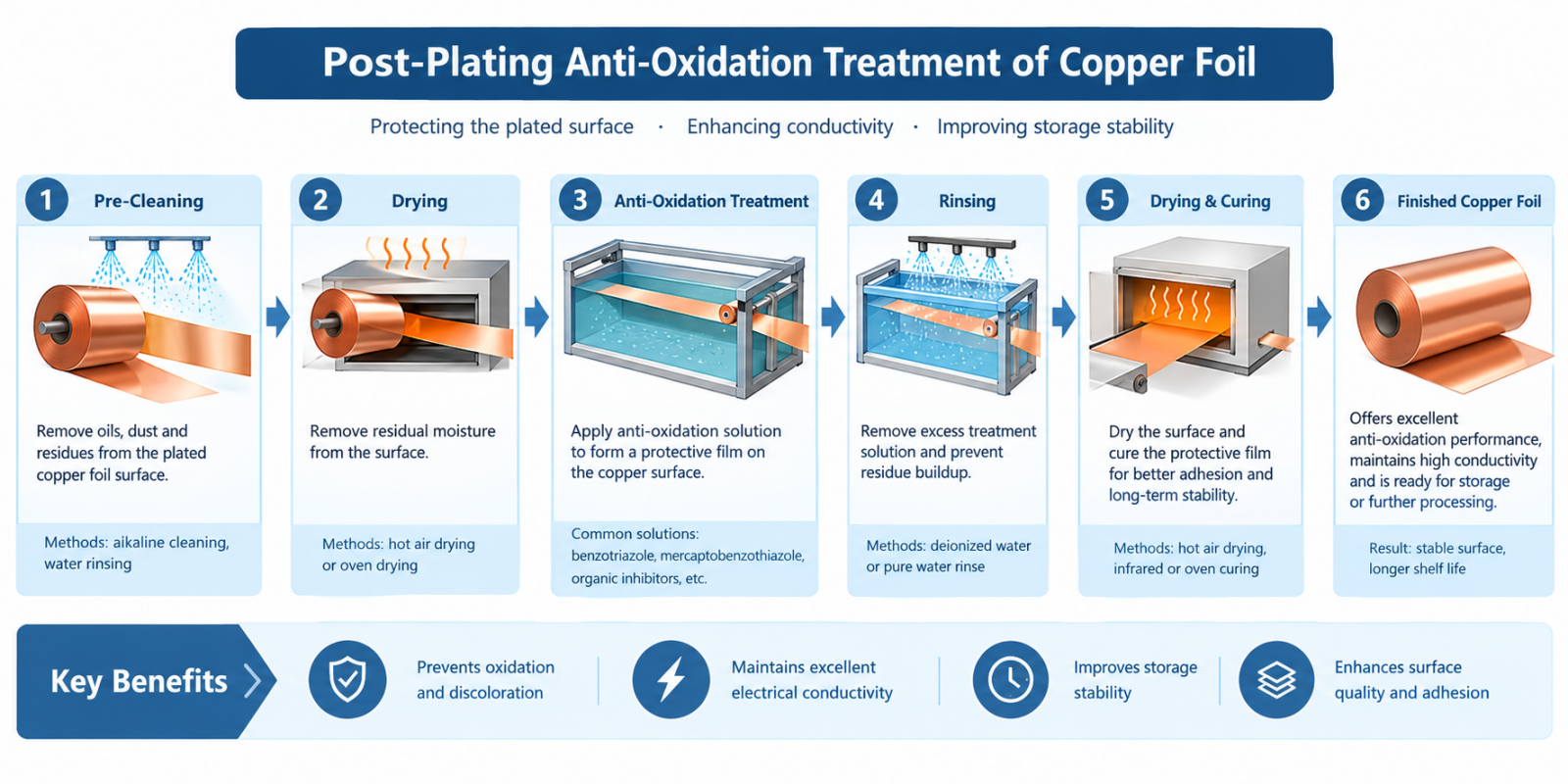
The mainstream industrial process today is eco-friendly organic passivation protection, which replaces the traditional highly polluting chromate-based inorganic passivation process. Its core principle is that organic corrosion inhibitors form an ultra-thin, dense protective film on the copper foil surface via chemical coordination, adsorption and crosslinking. This film isolates oxygen, moisture and corrosive media to achieve long-term anti-oxidation and anti-corrosion effects without impairing the electrical conductivity, subsequent soldering and lamination performance of copper foil. The overall process flow is simple: surface cleaning, chemical film formation, water rinsing and low-temperature curing. It is suitable for mass production of various types of copper foil.
2. Protection Mechanism of Benzotriazole and Its Derivatives
Benzotriazole (BTA) is a classic core raw material for copper protection. Its molecule contains a highly active triazole heterocyclic structure. Lone-pair electrons on nitrogen atoms can form stable Cu–N coordination bonds with ions on the copper surface, rapidly adsorbing and covering active sites of copper foil. Dense passivation films are formed through molecular polymerization to effectively suppress oxidation and electrochemical corrosion, while delivering good compatibility and film-forming stability.
However, neat BTA has obvious drawbacks: poor water solubility, narrow adaptable pH window for processes, weak high-temperature weather resistance and insufficient long-term protection capacity, making it hard to meet stringent aging test requirements for high-grade copper foil. For this reason, benzotriazole derivatives have been developed via molecular structure modification in the industry. They effectively improve the solubility, thermal stability and film compactness of the agent, reduce dosage and extend protection duration, and have become mainstream materials for post-electroplating treatment of high-grade copper foil.
Based on benzotriazole molecular modification technology, Wuhan Hugarise New Material Co., Ltd. has developed two different and innovative derivative products, precisely covering mass-production general scenarios and high-end high-weatherability protection scenarios, and addressing pain points of conventional agents including weak protection, poor high-temperature resistance and insufficient adhesion.
3. Differentiated derivative products: Precisely covering two types of protection scenarios.
(1) Methylbenzotriazole Derivative (PCU‑T)
PCU-T is a modified water-soluble eco-friendly antioxidant. Optimized to solve poor water solubility and high dosage of conventional BTA, it fully dissolves in pure water without organic solvents, complies with RoHS and suits all aqueous passivation lines.
It delivers stronger coordination activity and forms uniform films rapidly, covering microscopic defects and active sites on copper foil to block corrosive media. Featuring excellent process compatibility within neutral and weakly alkaline systems, it serves post-electroplating anti-oxidation for general electronic copper foil, standard lithium battery copper foil and copper alloys. With low dosage of 0.1%–0.3%, it replaces BTA and methylbenzotriazole. Treated copper foil achieves good corrosion inhibition, ideal for large-scale continuous production.
(2)Benzotriazole Silane Oligomer (PCU‑B)
PCU‑B is a premium organosilicon-modified composite antioxidant. It innovatively combines benzotriazole corrosion-inhibiting moieties and silane crosslinking groups to form a dual-layer protection system: inner coordination passivation and outer silane barrier, tailored for ultra-high weather resistance.
Inner benzotriazole groups strongly coordinate with copper ions to form a stable anti-corrosion base layer and suppress electrochemical corrosion. Outer trimethoxysilyl groups hydrolyze and crosslink into a dense inorganic silane film, boosting compactness, thermal stability and salt-spray resistance. It overcomes poor heat resistance, peeling and aging defects of conventional organic films. Its silane network improves interlayer adhesion between copper foil and resin substrates to avoid delamination. Heavy-metal-free and low-volatile, it targets high-frequency high-speed PCB, ultra-thin flexible and high-end power battery copper foil for rigorous electronics manufacturing requirements.
4. Specialized and differentiated anti-oxidation solutions for copper foil
Wuhan Hugarise New Material Co., Ltd. specializes in copper foil electroplating and post-treatment. Focused on key challenges of copper foil anti-oxidation, with solid expertise in formula development and process optimization, we have developed a line of additives for industrial mass production. We deliver tailored anti-oxidation solutions for various copper foils, working conditions and protection requirements, solving typical defects of electroplated copper foil such as discoloration, corrosion, poor weather resistance and insufficient adhesion.